
How to Choose the Right Electric Bike for Daily Commuting
Choosing the right electric bike for daily commuting can transform your ride from stressful to efficient and enjoyable. The right e-bike improves travel time, reduces sweat, and lowers transport costs—but only if it matches your route, storage, and lifestyle.
This guide cuts through marketing claims and focuses on practical choices: bike type, motor and battery, range, fit, everyday accessories and storage. Use these factors to make an informed pick that will reliably serve your weekday routine.
Why ride an e-bike to work?
Electric bikes shorten commute time, extend your realistic range, and let you arrive at work fresher than a conventional bike. They also can replace a car for many urban commutes, reducing parking hassles and running costs. If you want a bike tailored for daily use, start by looking at purpose-built Electric Commuter Bikes—these models prioritize upright ergonomics, reliable lights, fenders and racks.
Types of commuter e-bikes and which suits you
Commuter e-bikes come in several styles. Key choices are:
- Commuter/urban bikes — stable, comfortable, with rack and mudguard mounts.
- Folding e-bikes — compact for mixed-mode trips (train + bike) or tight storage.
- Road and fitness e-bikes — faster and lighter for longer, smoother commutes.
- Fat-tire or mountain-style e-bikes — best if your route includes rough surfaces or snow.
If you need to carry your bike onto public transport or store it in a small office, consider Electric Folding Bikes—they fold quickly and are designed to be portable without sacrificing a usable battery and motor.
Motor types, power and conversion options
Two common motor placements are hub motors and mid-drive motors. Hub motors are simple, low-maintenance and often cheaper; mid-drive motors deliver better hill-climbing performance and integrate well with the bike’s gears. For riders upgrading an existing bicycle, conversion kits are an option—especially if you want to retain a particular frame or geometry.
If you’re considering upgrading components rather than buying new, investigate Electric Bike Battery Conversion Kits and related conversion options so you understand compatibility, range trade-offs and installation effort.
Range, battery capacity and charging in everyday use
Estimate realistic range using your route distance, elevation and riding mode. Manufacturers often quote maximum ranges under ideal conditions—expect lower figures in stop-start city rides or on hills. Battery capacity (Wh) is the main determinant of range; higher voltage and amp-hour batteries give more usable distance but add weight.
For commuters who value portability and easy charging at the office or home, look for removable batteries and efficient chargers. A compact, removable-battery commuter like the Finbike U4 Electric Bike shows how a foldable frame and removable battery can make charging and storage simpler.
Fit, frame and comfort for daily rides
Comfort beats speed for daily commuting. Prioritize a frame that positions you upright enough to see traffic, a saddle you can ride for 30+ minutes without discomfort, and a handlebar height that avoids wrist and neck strain. Test rides are essential—ride at your typical commute pace, preferably on a similar route with similar stops and hills.
Other comfort features to consider: suspension seatposts or front forks for rough city streets, tires with puncture protection, and built-in fenders to keep you dry in wet weather.
Accessories that make commuting practical
Small accessories multiply an e-bike’s usefulness: reliable integrated lights, a robust rack or panniers, a kickstand rated for e-bike weight, and a good lock. For security, choose an alarmed disc lock or heavy-duty option to deter theft and protect your investment. A proven product example to consider is the Disc Lock with Alarm, which adds an audible deterrent and compact physical security.
Transporting and storing your e-bike
How you transport and store your e-bike affects your buying decision. If you drive part of your commute, check roof or boot compatibility; trunk-mounted and hitch racks must support the weight and battery connection. Look at dedicated Electric Bike Car Racks designed to carry heavier e-bikes safely.
For storage at home or work, wall hangers and stands save space: Electric Bike Wall Mounts lift the bike vertically and keep it off the floor. If you park outdoors or in a shared area, weather protection helps preserve components—consider a tailored Electric Bike Covers to keep moisture and grime off the battery and electronics.
Maintenance, warranties and cost of ownership
Factor routine maintenance into your decision: tire replacements, brake pads, drivetrain servicing and battery care. Ask about warranty coverage for the frame, motor and battery, and check local service options. A well-serviced mid-range commuter often costs less per year than a car once you include fuel, parking and insurance.
Checklist: Quick buying guide
- Route analysis: distance, hills, road surface and mixed transport needs.
- Choose bike type: commuter, folding, road, fat-tire based on route.
- Decide motor type: hub for simplicity, mid-drive for hills/performance.
- Target battery range with 20–30% safety margin over daily round-trip.
- Check removable battery, charger type and charging time.
- Confirm frame fit via a test ride and posture comfort.
- Buy essential accessories: lights, rack/panniers, alarmed lock and fenders.
- Plan storage: wall mount or cover and transport: car rack if needed.
FAQ
- How far will an e-bike go on a single charge? Typical commuter e-bikes with 400–600Wh batteries do 30–80 km depending on assistance level, terrain and rider weight.
- Can I convert my regular bike to electric? Yes—conversion kits exist for hub and mid-drive setups, but compatibility, installation complexity and battery placement vary. Assess cost versus buying a ready-made commuter.
- Do e-bikes need special maintenance? Maintenance is similar to regular bikes but include battery care, occasional motor checks and ensuring high-current connectors stay clean and dry.
- Is it safe to charge the battery overnight? Modern e-bike batteries have BMS safety features; follow manufacturer charging instructions and avoid charging on combustible surfaces.
- How do I prevent theft? Use a strong lock, park in visible areas, remove the battery if possible and consider an alarmed disc lock to add a deterrent.
Conclusion
Choosing the right electric bike for daily commuting starts with matching bike type to your route, confirming realistic battery range, testing fit, and planning storage and security. Prioritize practical features—removable batteries, sturdy racks, integrated lights and a reliable lock—over flashy specs. With the right choices, an e-bike becomes a dependable, economical commuting tool that fits your daily life.
Products Featured in This Article
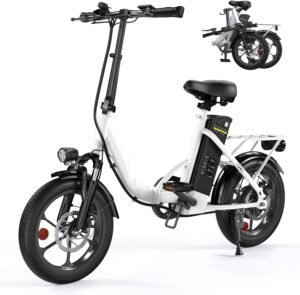
Finbike U4 Electric Bike, 16″…
Max Range: 60KM in pedal assist mode (depending on various factors, such as road conditions, user’s…

Disc Lock with Alarm, Bike Motorbik…
This alarm-equipped motorcycle locks high security is your bike’s ultimate guardian. Crafted from high-strength alloy steel…
